

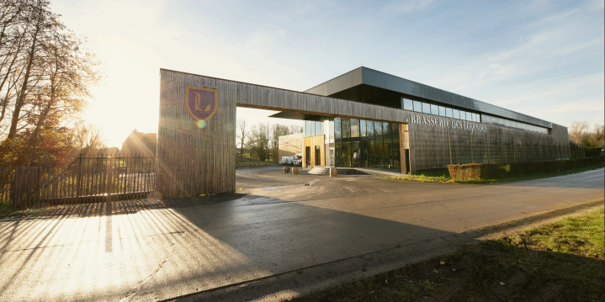
Can a craft brewery also be a model of sustainability? At the Brasserie des Légendes, the answer has been a wholehearted “yes” for more than 25 years. Under the leadership of Pierre Delcoigne, the brewery is steadily building a future-proof model in which environmental and social responsibility go hand in hand with economic viability.
Sustainability as a strategic investment
What is often seen today as an obligation, the Brasserie des Légendes has for years regarded as a deliberate investment. Guided by its core values, the brewery began reducing its footprint two decades ago: using less energy, less water and significantly phasing out fossil fuels.
These choices have proved beneficial not only for the environment, but also for the company itself. In the medium term, they are already yielding positive results, and in the long term, they are essential for a company to remain viable in a world where energy and raw materials are becoming increasingly scarce. For the Brasserie des Légendes, sustainability is therefore not a trend, but a strategy to remain relevant and resilient in the future.
Locally brewed
One of the first and most fundamental steps was the choice of a local supply chain. The brewery works exclusively with malting barley from a local farmer less than 20 km from the brewery. Close partnership creates a shared commitment and a product rooted in the local terroir.
Social responsibility is also an integral part of their vision. The brewery works with adapted work organisations and social enterprises, actively involving people who face barriers to employment in the production process. This not only strengthens the local community but also brings greater meaning to entrepreneurship.
Renewable energy
The brewery is strongly committed to generating energy from renewable sources. Both photovoltaic and solar boiler panels have been installed, producing electricity and hot water, both essential to the brewing process.
In addition, the excess heat is recovered in a smart way. Using a heat pump, heat from the fermentation tanks is captured, stored and reused to heat the warm storage rooms and offices. This circular system significantly reduces energy consumption and shows how innovation and efficiency work together.